When Silence Becomes a Decision
Under the Freedom of Information Act 1982 (Cth), if an agency doesn't respond within 30 days, the law treats silence as a refusal. You can seek review as if they'd said no.
This is called a deemed refusal.
It's meant to protect applicants from indefinite delay, but it reveals how process design creates the conditions for failure.
Why Agencies Miss Deadlines
Deemed refusals aren't usually deliberate. They happen because:
- Consultation requirements pull requests into multi-agency loops with no clear ownership
- Third-party consultation extends the statutory timeframe, but adds coordination overhead across multiple parties with no single point of accountability
- Decision-maker availability becomes a bottleneck when FOI sits with busy executives
- Exemption analysis takes longer than the statute assumes
The system assumes every request is straightforward. When it isn't, delay becomes structural.
What the Pattern Shows
According to the OAIC, deemed refusals tend to occur in predictable patterns:
- Requests involving multiple agencies (no single point of accountability)
- Requests requiring ministerial consultation (competing priorities)
- Requests for Cabinet documents (high-stakes exemption analysis)
The pattern isn't random. It's a symptom of process architecture that doesn't match operational reality.
What Happens After a Deemed Refusal
A deemed refusal doesn't end the process. It shifts it to review.
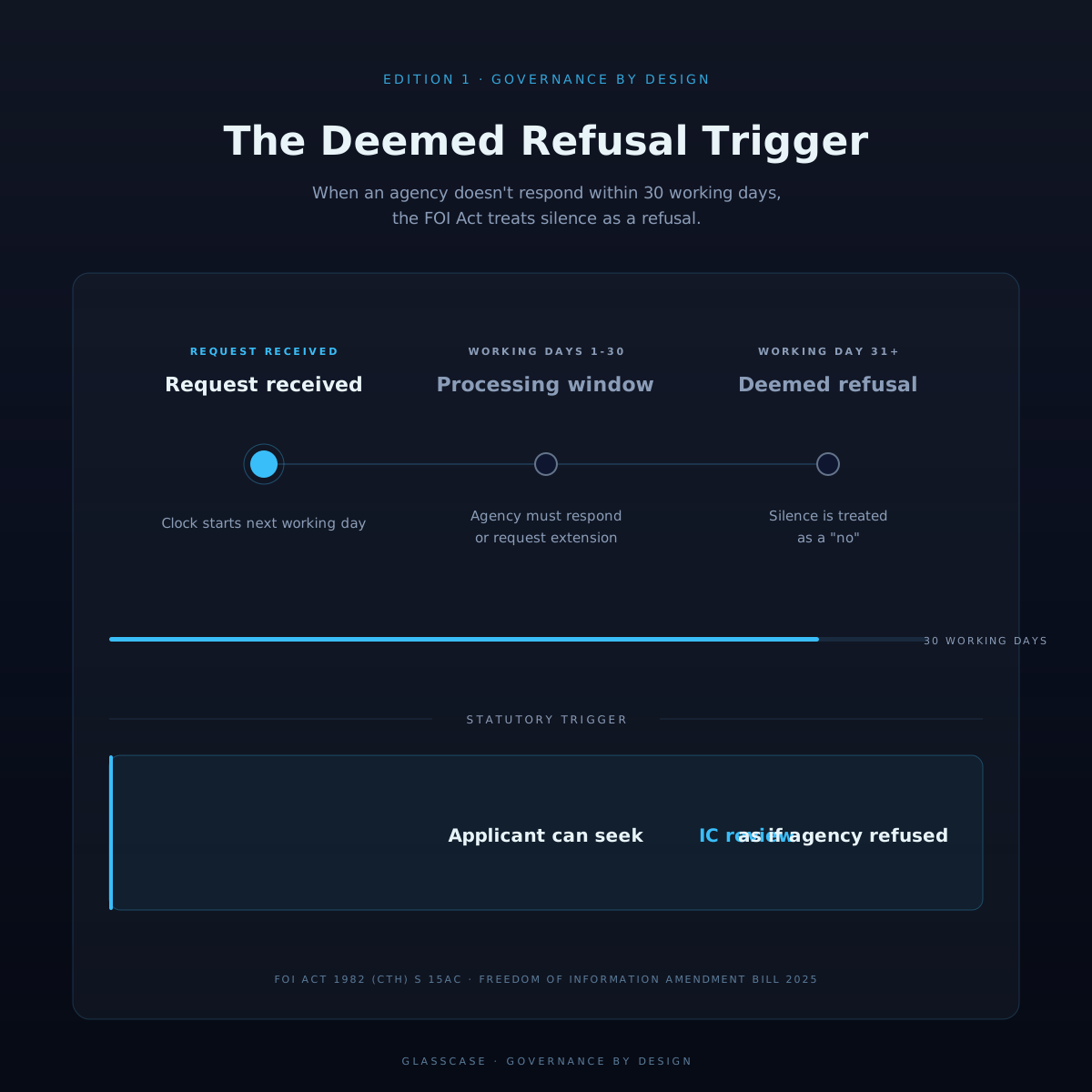
In Attorney-General (Cth) v Patrick [2024] FCAFC 126, the Full Federal Court confirmed that applicants can seek IC review of the actual decision once made, not the deemed refusal.
The Freedom of Information Amendment Bill 2025 (Cth) (passed House of Representatives, 6 November 2025) would codify this and extend processing timeframes from 30 calendar days to 30 working days, effectively adding 8-10 days to the deadline.
The Freedom of Information Amendment Bill 2025 was discharged from the Senate on 5 March 2026. The Bill did not pass and will not become law unless reintroduced in a later Parliament. Senator Gallagher indicated the Government would continue to engage on the final form of FOI Act reforms. Senators across parties agreed on the need to modernise the FOI Act but raised concerns about proposed charges, AI interaction with FOI, and conflict with the Act's transparency and accountability objects.
The underlying design problem this edition describes — deemed refusals driven by structural process failures — remains unchanged.
This may reduce deemed refusals, but it also delays access.
Governance Relevance
If you're designing a decision-making system, deemed refusals are a useful case study:
- Statutory timeframes don't enforce themselves. You need workflow design that makes deadlines visible and creates intermediate checkpoints.
- Consultation requirements need handoff protocols. If three agencies must weigh in, who owns the timeline?
- Discretion needs documentation infrastructure. If the decision-maker can't articulate reasons quickly, the process hasn't scaffolded their thinking.
Deemed refusals aren't an FOI problem. They're a governance design problem that FOI makes visible.
A Note on the Bill
The Freedom of Information Amendment Bill 2025 (Cth) (the Bill) passed the House on 6 November 2025, before the Senate committee examining the Bill reported on 3 December 2025.
A separate December 2023 Senate inquiry had already found the Commonwealth FOI system "not fit for purpose" and recommended comprehensive reform, including statutory review timeframes and abolishing internal reviews.
Every major review since 2013 (Hawke, Shergold, Thodey) has called for a comprehensive independent review of the FOI Act. The Bill implements recommendations that ease agency burden (working days, processing caps) while declining those that strengthen applicant rights (statutory review timeframes, abolishing internal reviews).
The Royal Commission into Robodebt also called for tighter limits on Cabinet confidentiality.
The Bill expands them.
The Bill was discharged from the Senate on 5 March 2026 without passing. The structural reform it proposed — including extended processing timeframes and expanded Cabinet exemptions — did not proceed. The underlying FOI Act remains unamended.
When reasons at the highest level get harder to see, reasons at every other level matter even more.
Edition 2 picks up there.
Next Edition
Edition 2 examines reasons for decision: what the law requires, what agencies provide, and why the gap matters for procedural fairness.
— Jay
Sources
- Attorney-General (Cth) v Patrick [2024] FCAFC 126. https://upload.wikimedia.org/wikisource/en/b/b4/Attorney-General_%28Cth%29_v_Patrick_%282024%2C_FCAFC%29.pdf
- Freedom of Information Act 1982 (Cth). https://www.austlii.edu.au/cgi-bin/viewdb/au/legis/cth/consol_act/foia1982222/
- Freedom of Information Amendment Bill 2025 (Cth). https://www.aph.gov.au/Parliamentary_Business/Bills_Legislation/Bills_Search_Results/Result?bId=r7371
- Office of the Australian Information Commissioner. (n.d.). Fact sheet for freedom of information practitioners. https://www.oaic.gov.au/freedom-of-information/freedom-of-information-guidance-for-government-agencies/guidance-on-handling-a-freedom-of-information-request/checklists,-handouts-and-templates/fact-sheet-for-freedom-of-information-practitioners-to-give-to-staff
- Royal Commission into the Robodebt Scheme. (2023). Report. https://robodebt.royalcommission.gov.au/
- Senate Legal and Constitutional Affairs References Committee. (2023, December). The operation of Commonwealth Freedom of Information (FOI) laws. https://www.aph.gov.au/Parliamentary_Business/Committees/Senate/Legal_and_Constitutional_Affairs/CommonwealthFOI2023
Comments