A single chain of failure runs through the Commonwealth Freedom of Information (FOI) system. Decisions not made. Decisions made without reasoning. Review that cannot reach the decision.
At each stage, the statute's formal trigger fires, while the corrective force diminishes.
The chain is not three separate failures. It is one failure expressed four ways, produced by the absence of a design layer between legal obligation and institutional behaviour. In the final edition of this four-part arc, Edition 4 asks whether design can close that gap, and what that would require.
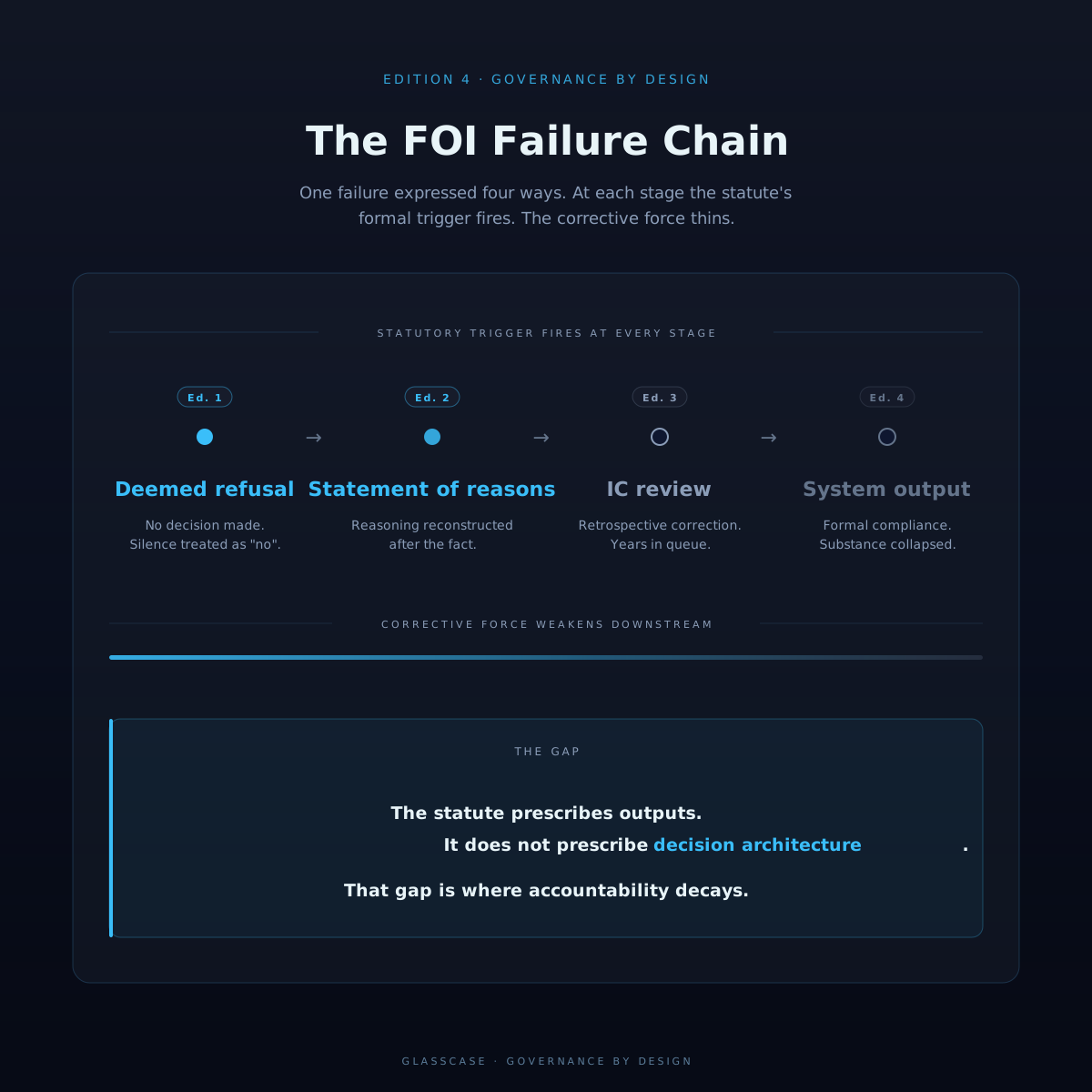
The Freedom of Information Act 1982 (Cth) (FOI Act) prescribes outputs and timeframes. It does not prescribe internal reasoning processes or decision architecture. That gap is where accountability decays. Design is the missing layer.
FOI-Specific or Systemic?
It is tempting to treat the problems described in these editions as FOI pathologies. But deemed refusals, inadequate reasons and review delay are not unique to FOI. They appear wherever administrative decision-making operates under statutory obligation without supporting process architecture.
The Robodebt Royal Commission documented a similar structural failure: legal advice identifying the scheme's illegality was left in draft form and not formally adopted within departmental decision processes, meaning key operational decisions proceeded without recorded legal reasoning capable of external scrutiny (Royal Commission into the Robodebt Scheme, 2023).
FOI makes these problems visible. The Act's transparency requirements expose what other statutory schemes conceal.
What the FOI System Reveals
Four features of Commonwealth administrative decision-making emerge clearly when FOI is used as the lens:
1. Documentation is organised around outputs, not reasoning
FOI workflows track documents and deadlines. They do not capture the analytical steps between receiving a request and producing a decision. When reasoning is never recorded, reasons become reconstruction written after the fact to satisfy a statutory trigger.
In many systems, the case file records the request, the documents located and the final decision notice. It does not record the intermediate reasoning: which exemption provision was considered first, what facts were relied on, or why competing public interest factors were weighed that way.
2. Workflow ownership is diffuse
Consultation requirements distribute decision-making across agencies without assigning timeline accountability. A request may remain with the originating agency, move to another agency for consultation under s 15(6) of the FOI Act, and then wait for ministerial clearance.
Each step is lawful. None carries ownership of the statutory clock.
As at May 2024, 59% of IC review applications received by the Office of the Australian Information Commissioner (OAIC) originated from deemed access refusals — requests where agencies had not made a decision within the statutory processing period.
This suggests that delay, rather than disagreement over exemptions, is a major driver of FOI disputes.
3. Review architecture is retrospective by design
Information Commissioner (IC) review tests decisions after they are made. It cannot participate in their production. When the corrective layer is structurally separated from the decision layer, upstream quality depends heavily on agency self-discipline. That discipline weakens when review is slow or unlikely.
4. Incentives favour compliance form over substance
Agencies produce statements of reasons because the statute requires them. The incentive is to satisfy the statutory trigger, not to reason well. Where review backlogs mean a deficient decision may never be tested, even that incentive fades.
The oldest IC review matter before the OAIC peaked at 65 months in 2023-24 and stood at 56 months after the first reduction in a decade in 2024-25.
When review operates on multi-year timelines, its ability to influence decision quality upstream becomes structurally weak.
Why Design Matters
Legal scholar Lawrence Lessig argued that behaviour is shaped by architecture — the design of the systems people move through. A speed bump slows traffic the same way a speed limit does, but without a single word (Lessig, 2006, p. 128). FOI is a test of that proposition in Commonwealth administrative practice.
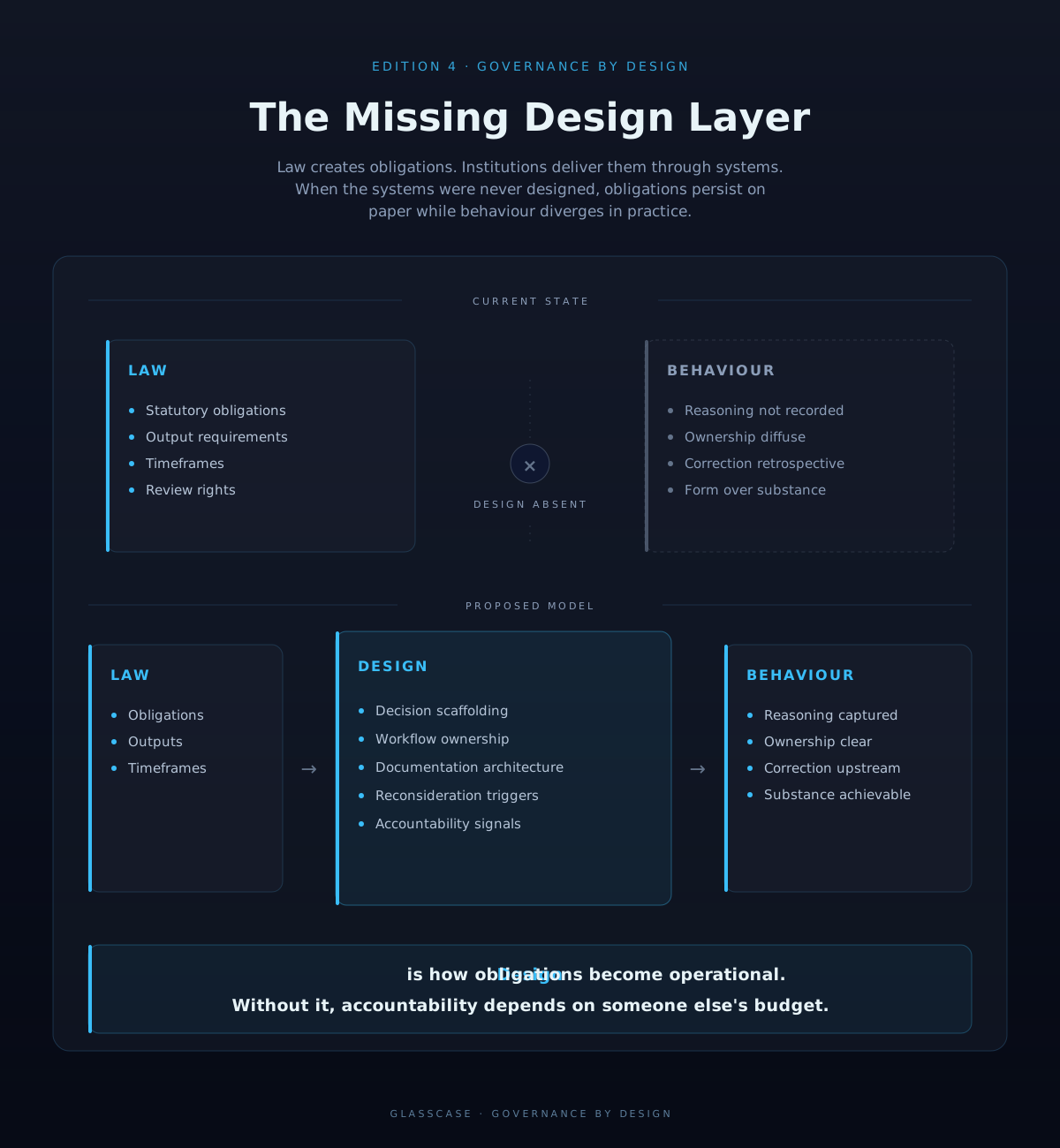
Law creates obligations. Institutions deliver them through systems: workflows, templates, escalation protocols, documentation tools and review pathways.
When those systems are absent or misaligned, legal obligations persist on paper while institutional behaviour diverges in practice.
The gap between legal obligation and institutional capacity is often framed as a resourcing problem. But design determines how resources translate into performance. A system whose decision architecture was never designed for the obligations the statute creates will underdeliver regardless of what it is given.
Design Responses
Five interventions that address the failures identified in Editions 1-3. Each is institutional.
1. Decision scaffolding
Require exemption decisions to pass through structured templates that force separation of the analytical steps administrative law already expects: material facts, evidence relied upon, the exemption provision engaged, public interest factors for and against and the weighing rationale.
Not a checklist. A reasoning architecture that makes those steps unavoidable.
For conditional exemptions, the OAIC already requires weighing, not recitation. The scaffolding makes that standard achievable. The decision template requires the officer to record each exemption element and the evidence supporting it before a refusal can be issued.
2. Workflow ownership
Assign a single process owner per FOI request with authority to escalate consultation delays. Statutory timeframes need internal intermediary checkpoints, not just a 30-day endpoint that arrives without warning.
3. Documentation architecture
Shift from document-tracking systems to reasoning-capture systems. Record the decision-maker's analytical steps contemporaneously, not retrospectively. If reasoning exists only in the statement of reasons, it was never part of the decision.
4. Automatic reconsideration trigger
If an IC review has not commenced within 12 months, agencies could implement an automatic reconsideration trigger — requiring fresh consideration of the original decision.
The reconsideration must be paired with the scaffolding above. Without it, the same incentive environment produces the same output.
This moves the corrective function upstream when the downstream layer cannot operate, without adding complexity to the review system itself.
5. Accountability signals
Publish agency-level data on deemed refusal rates, IC review overturn rates and average review resolution times.
Aggregate data already exists; the gap is named, comparable, agency-level publication. Transparency about system performance creates institutional pressure that individual case review cannot.
FOI as Diagnostic Instrument
FOI is unusual among Commonwealth statutory schemes because it forces agencies to show their reasoning. Most administrative decision-making does not. This makes FOI a diagnostic tool for the quality of administrative decision-making itself.
Where FOI reason-giving fails, it is reasonable to ask whether reason-giving in less transparent statutory contexts is any better, or simply less visible.
Closing
Across the earlier pieces in this series, the FOI system was shown to produce the formal outputs the statute requires: deemed refusals, statements of reasons and review queues, while the substance thins at every stage.
The response is to redesign the architecture so that better behaviour is the path of least resistance.
Compliance asks whether the steps were followed. Accountability asks whether the people the system serves can tell whether the steps were followed. The FOI system currently answers the first question; it rarely answers the second.
Accountability is not produced by legal rights alone. Rights create obligations. But obligations require systems to become operational.
Accountability that depends on review alone is accountability that depends on someone else's budget.
Coming Up
The argument here moved from symptom to diagnosis and then to a design response, anchored in the FOI Act. With that arc complete, where does Governance by Design go next?
FOI as a diagnostic instrument for Commonwealth administrative decision-making invites the next step outward. The framework now needs to be tested against other decision systems where the same structural pressures appear.
The upstream question follows from there: why statutes consistently create obligations without the process architecture required to deliver them.
— Jay
Sources
- Freedom of Information Act 1982 (Cth). https://www.legislation.gov.au/C2004A02562
- Harvard Law School. (n.d.). Lawrence Lessig. https://hls.harvard.edu/faculty/lawrence-lessig/
- Lessig, L. (2006). Code version 2.0. Basic Books.
- Office of the Australian Information Commissioner. (2025). Annual report 2024-25. https://www.oaic.gov.au/about-the-oaic/our-corporate-information/oaic-annual-reports/annual-report-2024-25
- Office of the Australian Information Commissioner. (2024, May 30). Senate estimates opening statement May 2024. https://www.oaic.gov.au/newsroom/senate-estimates-opening-statement-may-2024
- Royal Commission into the Robodebt Scheme. (2023). Report of the Royal Commission into the Robodebt Scheme. https://robodebt.royalcommission.gov.au/publications/report
Comments