
When Reasons Stop Being Reasons
Edition 1 examined Freedom of Information (FOI) at the point of silence, deemed refusals where statutory timeframes expire without a decision.
Edition 2 examines FOI at the point of speech, where reasons are given but don't hold.
The shift is from process failure to reasoning failure. Both reveal how decision design creates the conditions for breakdown.
This edition argues that inadequate reasons in FOI decisions are not a drafting failure but a failure of decision design, where exemption analysis and public interest weighing lack structural support and review merely exposes the gap.
What the Law Requires
Administrative decisions must be supported by reasons. The obligation exists at two levels:
First, section 13 of the Administrative Decisions (Judicial Review) Act 1977 (Cth) (ADJR Act) gives any person entitled to seek judicial review the right to request a statement of reasons. If the statement lacks adequate particulars of findings, evidence, or reasons, the Federal Court may order "further and better particulars" (s 13(7)).
Second, in FOI matters, this function is performed directly by s 26 of the Freedom of Information Act 1982 (Cth) (FOI Act); s 13 of the ADJR Act supplies the broader administrative law standard against which the adequacy of reasons is judged.
FOI Act s 26 requires agencies to provide a statement of reasons for decisions to refuse or defer access. The statement must include:
- findings on material questions of fact
- the evidence or material on which those findings were based
- public interest factors considered (for conditional exemptions)
- the decision-maker's name and designation
- review rights
Office of the Australian Information Commissioner (OAIC) FOI Guidelines [3.127], [3.134] reinforce the obligation:
"An administrative decision must be based on facts. A central obligation of a decision-maker is therefore to identify and separate the 'material questions of fact'; gather and assess information or evidence to support each finding of fact; and explain how each finding of fact was reached."
"Members of the public are entitled to know the reasons why an administrative decision that affects them has been made. Giving reasons promotes fairness, transparency and accountability."
OAIC FOI Guidelines [6.237]–[6.238] make explicit what many agencies miss:
"In weighing the factors for and against access to a document, it is not sufficient simply to list the factors. The decision maker's statement of reasons must explain the relevance of the factors and the relative weight given to them."
"The decision maker must analyse, in each case, where on balance the public interest lies based on the particular facts at the time the decision is made."
Weighing, not recitation. Analysis, not inventory.
Case law standards confirm this. In Minister for Immigration and Ethnic Affairs v Wu Shan Liang (1996) 185 CLR 259, the High Court held that reasons should be read fairly, not with an eye keenly attuned to error. But fairness in reading doesn't excuse failure in writing. The Full Federal Court in Minister for Home Affairs v Buadromo [2018] FCAFC 151 emphasised that decision-makers must engage in an active intellectual exercise and consider representations in a meaningful way.
What Agencies Actually Provide
The pattern of failure is consistent: exemption reasoning that is conclusory rather than analytical, public interest balancing that lists factors without weighing them, and findings that don't connect evidence to conclusions.
'YF' and Services Australia [2021] AICmr 59 shows this pattern clearly.
The applicant requested documents about the Pension Loans Scheme. Services Australia refused access to parts of 25 documents, claiming multiple exemptions. The Information Commissioner (IC) set aside the decision. The agency's reasoning failed at multiple points.
The Commissioner rejected the agency's approach to relevance (s 22) and deliberative processes (s 47C), finding that Services Australia had drawn artificial distinctions and relied on generic assertions rather than document-specific analysis.
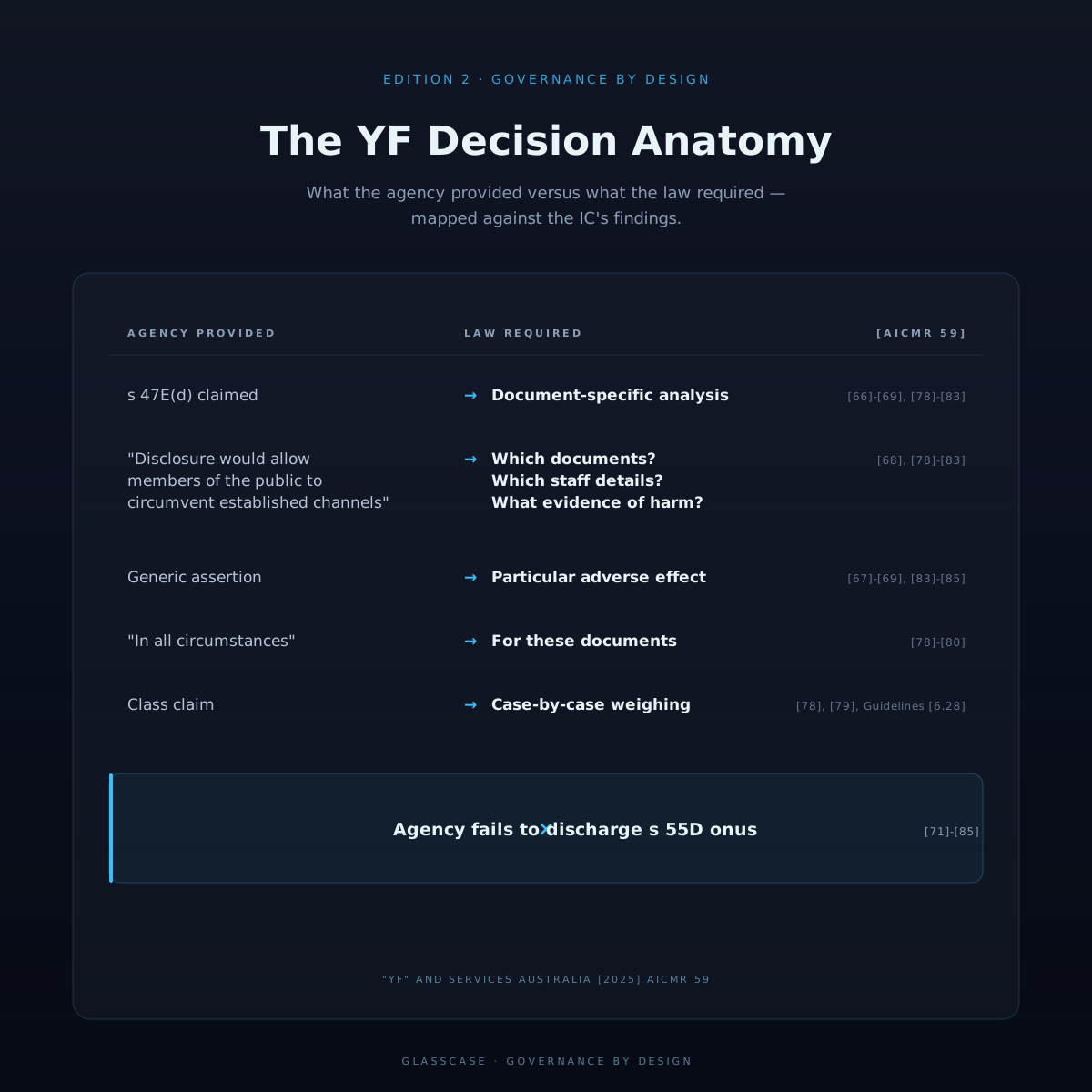
On operations of agencies (s 47E(d)):
The agency claimed disclosure of staff names and contact details would allow members of the public to circumvent established channels, diverting staff from critical services and jeopardising record-keeping integrity.
The Commissioner found at [78]–[83] that the agency's reasons were "framed in general terms" and appeared to contend that disclosure would have a substantial adverse effect "in all circumstances." This was a class claim—exactly what OAIC FOI Guidelines [6.28] prohibits for conditional exemptions.
The agency had not established that disclosure of the particular documents would have the predicted substantial adverse effect. It had made broad assertions without evidence.
The decision was set aside because the agency failed to meet its onus under s 55D.
The structure of this failure is shown below:
What YF shows:
The agency went through the motions. It identified exemptions. It listed public interest factors. It produced a statement of reasons. But the reasoning didn't do the work. The system produced an output that looked like reasons. But when tested, it failed.
The Practitioner's Perspective
The Sparke Helmore practitioner note by Molly Campbell and Chantal Tipene on deemed refusals reveals something important about how reason-giving changes under review pressure.
When a decision is deemed under s 15AC, the agency may still issue a Statement of Reasons. But it is not the decision. The deemed refusal is. The document describes a decision that would have been made had the request been processed in time.
This creates semantic shifts: "I decided" becomes "I am satisfied I would have decided." The decision is retrospective justification, not contemporaneous reasoning.
Once time collapses, reasons stop being part of the decision-making process. They become a retrospective account of what might have happened. At that point, the system is no longer producing reasons. It's producing explanations.
Why the Gap Matters
For procedural fairness and accountability:
Reasons serve two functions. They enable the affected person to understand why the decision was made. They enable review bodies to assess whether the decision was lawful. Without adequate reasons, both functions collapse.
OAIC FOI Guidelines [3.138]–[3.139] state that decision-makers are accountable for their decisions, and that the FOI Act contains detailed provisions for review and oversight. But accountability requires a documentary trail.
The Robodebt Royal Commission found systemic documentation failures—reasons that were never recorded, decisions that couldn't be traced, processes that left no evidence of who decided what, when. When reasons are inadequate, accountability becomes impossible.
For governance design:
Statutory timeframes create pressure. Complex requests involving consultation, exemption analysis, and public interest balancing take longer than the statute assumes.
Where the process fails to scaffold decision-making, reasons are not produced through reasoning but reconstructed after the fact to withstand review.
The system produces outputs that look like reasons but don't do the work of reasons.
Governance Relevance
If you're designing a decision-making system, reason-giving is where the design gets tested.
Exemption analysis needs structure.
If the law requires weighing factors, the system must surface what is being weighed and why. A checklist that says "consider public interest factors favouring disclosure" cannot produce the analysis OAIC FOI Guidelines [6.237] requires. The decision-maker needs prompts that force articulation: which factor is stronger, why, and on what evidence.
Review exposure shapes output.
Reasons written for review look different from reasons written to explain. When the primary audience is the Information Commissioner or the Administrative Review Tribunal, reasoning becomes defensive. The question shifts from "What should I decide?" to "How do I justify what I've already decided?"
This isn't necessarily bad faith. It's structural. Once review is anticipated, reason-giving changes character.
Documentation infrastructure matters.
Agencies do not fail to give adequate reasons because they lack goodwill. They fail because the system gives them no scaffolding to think. A decision-maker cannot articulate findings, evidence and weighing if the process never required those steps to exist in the first place.
Most FOI workflows collect documents, not reasons. They track deadlines, not findings. They generate templates, not analysis. When the structure doesn't force the decision-maker to separate facts, evidence and public interest factors at the point of decision, reasons become an afterthought that must be reconstructed under time pressure.
You cannot retrofit reasons onto a process that never created them.
Where documentation infrastructure is thin, reasoning collapses into assertion.
Where scaffolding is absent, reasons are not produced, they are improvised.
Adequate reasons require decision design that makes reasoning unavoidable.
What Comes Next
Edition 2 examined what happens when reasons are given but don't do the work.
Edition 3 examines what happens when the system that produces reasons is itself under stress.
Patrick v Australian Information Commissioner (No 2) [2023] FCA 530 showed IC review delays of years—not weeks or months. The Court found the IC had limited resources to deal with a large volume of reviews, resulting in applications lying dormant for long periods. But the deeper problem isn't delay alone. It's that the review system is structured to test agency decisions, not to create them.
When agencies issue deemed refusals or provide inadequate reasons, the IC inherits a gap that the system wasn't designed to fill.
When the review system is overloaded, even inadequate reasons may never be tested. When it's structurally misaligned, even timely review may miss what matters.
Edition 3 picks up there.
— Jay
Sources
- Administrative Decisions (Judicial Review) Act 1977 (Cth) s 13. https://www.legislation.gov.au/C2004A01697/latest/text
- Campbell, M., & Tipene, C. (2025, May 14). How do I finalise my reasons for a decision if my FOI matter has deemed? Sparke Helmore. https://www.sparke.com.au/insights/how-do-i-finalise-my-reasons-for-a-decision-if-my-foi-matter-has-deemed/
- Freedom of Information Act 1982 (Cth) ss 15AC, 22, 26, 47C, 47E, 55D. https://www.legislation.gov.au/C2004A02562/latest/text
- Minister for Home Affairs v Buadromo [2018] FCAFC 151. https://www.judgments.fedcourt.gov.au/judgments/Judgments/fca/full/2018/2018fcafc0151
- Minister for Immigration and Ethnic Affairs v Wu Shan Liang (1996) 185 CLR 259. https://www.austlii.edu.au/cgi-bin/viewdoc/au/cases/cth/HCA/1996/6.html
- Office of the Australian Information Commissioner. (2024). Freedom of Information Guidelines issued under s 93A of the Freedom of Information Act 1982 [3.127], [3.134], [3.138]–[3.139], [6.28], [6.237]–[6.238]. https://www.oaic.gov.au/freedom-of-information/foi-guidelines
- Patrick v Australian Information Commissioner (No 2) [2023] FCA 530. https://www.judgments.fedcourt.gov.au/judgments/Judgments/fca/single/2023/2023fca0530
- Royal Commission into the Robodebt Scheme. (2023). Report. https://robodebt.royalcommission.gov.au/publications/report
- 'YF' and Services Australia (Freedom of information) [2021] AICmr 59. https://www.austlii.edu.au/cgi-bin/viewdoc/au/cases/cth/AICmr/2021/59.html
Comments