
What the Court Found and Why It Matters
In Patrick v Australian Information Commissioner (No 2) [2023] FCA 530, the applicant sought judicial review of prolonged delay by the Australian Information Commissioner (IC) in determining IC review applications under the Freedom of Information Act 1982 (Cth) (FOI Act).
Patrick had seven IC review applications. Some had been waiting over two years. The Court found none of the delays legally unreasonable.
Relying on s 7(1) of the Administrative Decisions (Judicial Review) Act 1977 (Cth) (ADJR Act), Patrick argued the delay amounted to a failure to make a decision within a reasonable time.
The Federal Court accepted that the delays were substantial and that resource constraints were "unquestionable". However, Wheelahan J dismissed the application. In assessing whether delay was legally unreasonable, the Court held that regard must be had to the resources available to the decision-maker and the competing demands on those resources.
Judicial review of delay under s 7(1) ADJR Act is about legal unreasonableness. That threshold is high. It tolerates systemic imperfection. The Court is asking: given the statutory scheme and available resources, is this delay beyond what Parliament can be taken to have contemplated?
The IC's statutory functions extend to all IC review applications, not only those brought by the applicant.
Even if relief had been granted, the structural problem would have remained. As Wheelahan J observed, citing an American federal court:
"An order of the Court placing the applicant's applications for IC review 'at the head of the queue simply moves all others back one space and produces no net gain.'"
The Court was equally explicit about where responsibility lies:
"It is ultimately for the Commonwealth Parliament to legislate so as to appropriate monies to the Office of the Australian Information Commissioner in order to enable the discharge of the Commissioner's statutory functions."
Patrick exposes a structural gap between administrative capacity and legal remedy. Prolonged systemic delay may be politically troubling, yet not legally unreasonable.
The corrective function of IC review is, in many cases, practically unavailable. The accountability the system promises on paper is not always available in practice.
The Structural Misalignment
IC review is designed to test agency decisions after they are made. It is a corrective mechanism. Retrospective by design. It does not participate in the original decision-making process. It cannot ensure that adequate reasons are produced at the time the decision is made.
Edition 2 examined what happens when agencies provide reasons that are conclusory. When factors are listed but not weighed. When assertion substitutes for analysis.
IC review is meant to catch that.
But when reviews lie dormant for years because of caseload pressure, the corrective function is delayed. The original decision, however flawed, continues to govern the applicant's position.
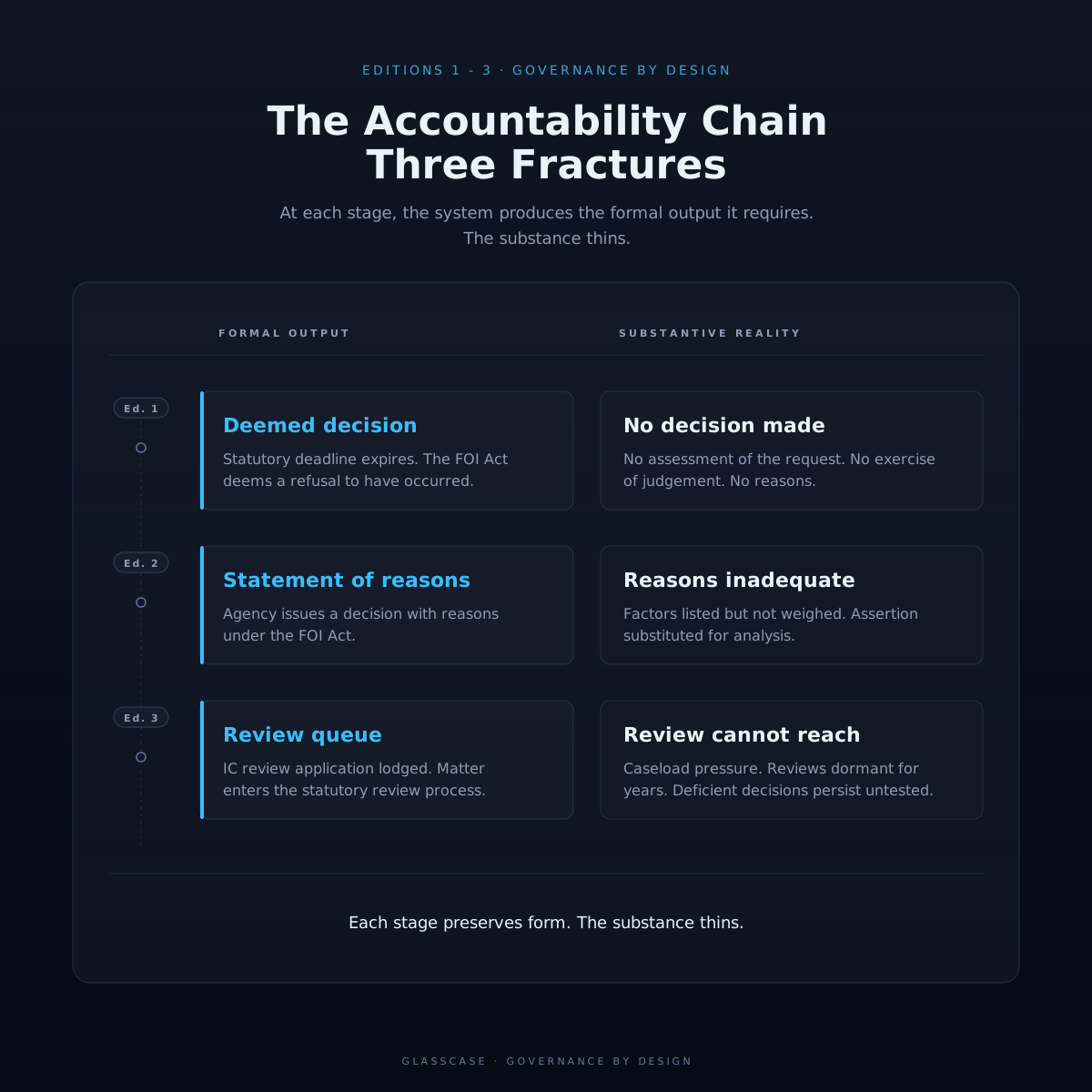
This is the third break in the accountability chain:
- No decision (Edition 1).
- Decision made, but reasons inadequate (Edition 2).
- Review exists in law, but cannot operate effectively in practice (Edition 3).
At each stage, the form of accountability remains.
- Deemed refusals preserve the appearance of process.
- Inadequate reasons preserve the appearance of reasoning.
- A multi-year review queue preserves the appearance of oversight.
The IC review problem does not stand alone.
The Administrative Review Tribunal, which replaced the AAT in October 2024, confirmed at Senate estimates on 9 February 2026 that it was carrying tens of thousands of migration matters while resolving less than a quarter of its on-hand caseload annually.
Migration review is volume-driven in a way FOI review is not, but the structural pattern is the same shape: a review body designed to test decisions operating under caseload pressures that limit its capacity to do so.
Why the Gap Matters
For applicants, the consequences are immediate.
An applicant who applies for IC review and waits years for a decision is not receiving review in any meaningful sense. The FOI right of access, legally enforceable under s 11 of the FOI Act, exists in statute, but its practical force depends on the capacity of the review mechanism.
The right is legal. Its enforcement is structural.
If review cannot be delivered within a reasonable timeframe, the statutory promise is functionally qualified by a resourcing decision made elsewhere.
For governance design, the implications are broader.
The review layer of any administrative system only matters if it can reach decisions in time to influence behaviour. If review is slow or inaccessible, agencies bear less practical accountability for the quality of their first-instance decisions.
Where a deficient decision is unlikely to be tested, the design pressure to produce better decisions at the source weakens.
The IC review framework was built on the assumption that reviews would occur within a reasonable time. The FOI Act says so expressly – s 55(4)(c) requires that IC reviews be conducted "in as timely a manner as possible."
A review right that cannot be exercised within a reasonable timeframe is not, in practice, a review right.
Within the FOI system, the problems compound.
Agencies sometimes produce reasons that are conclusory, that list factors without weighing them, that substitute assertion for analysis.
Review is meant to identify and correct those deficiencies, but when review itself is under prolonged strain, inadequate decisions persist untested. The original answer governs. The corrective layer cannot operate with sufficient speed to matter.
Patrick made this institutional limit explicit. The delay was real, the resource shortage was "unquestionable," and the Court had no effective remedy.
Judicial review of administrative delay is bounded by institutional constraints. Courts cannot appropriate budget, manage a caseload or reorder competing claims across a system. Responsibility ultimately rests with Parliament.
If resource constraints can render multi-year delay legally reasonable, then legality alone cannot guarantee timeliness. The boundary between lawful and acceptable becomes political rather than judicial.
If the review layer cannot operate as designed, the correction for agency failure has to move upstream.
One response is to embed decision discipline at first instance: require exemption decisions to articulate the statutory elements, identify the material facts relied upon, and explain why competing considerations were outweighed. Not to satisfy review years later, but to force analytical rigour at the point of refusal.
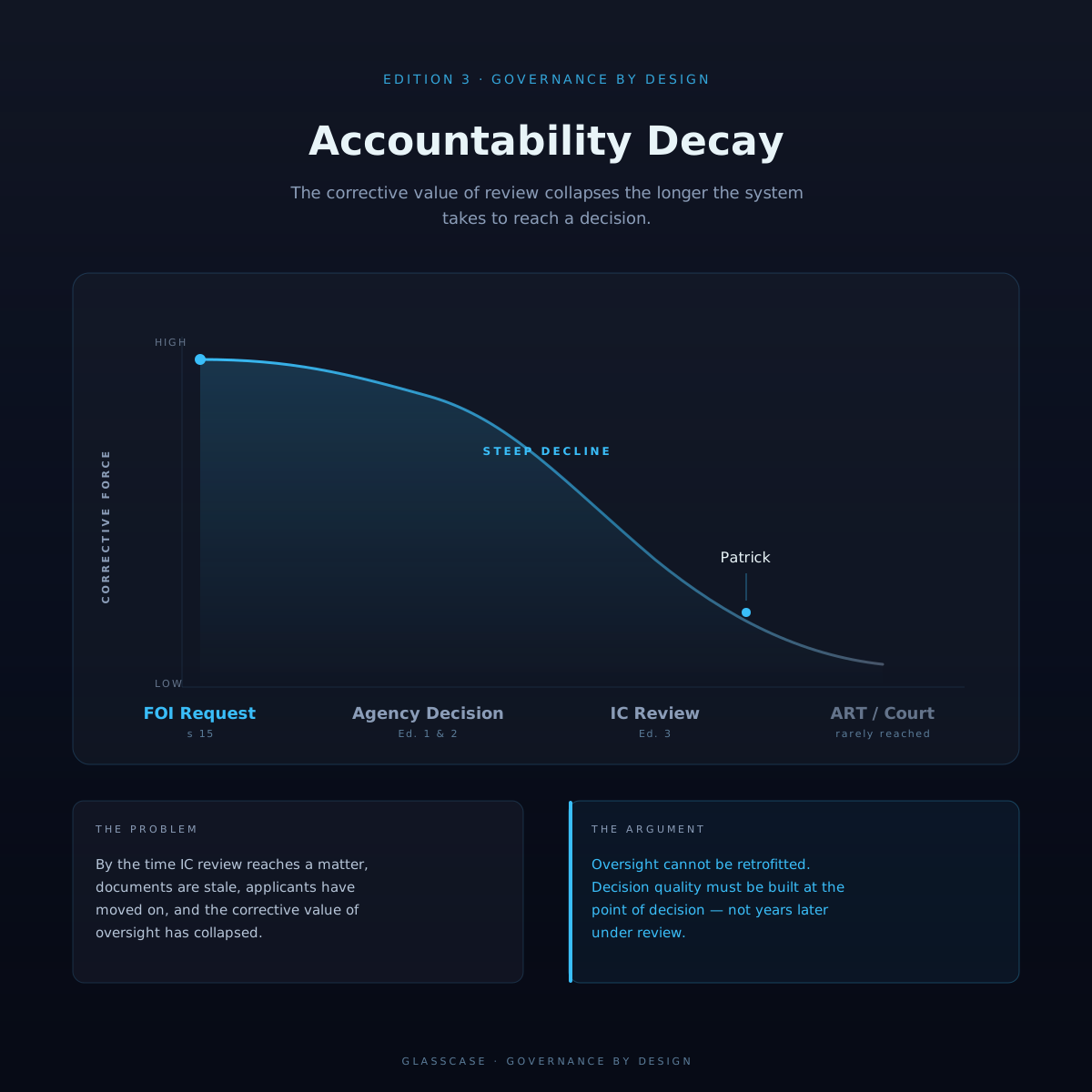
Decision quality must be built at the point of decision. Reasons must be adequate when first produced, not years later under review. By the time the IC reaches a matter, documents may be stale, circumstances may have shifted, and the practical utility of oversight may have collapsed.
Oversight cannot be retrofitted onto a system that was never designed to sustain it.
What Comes Next
Editions 1, 2 and 3 have traced a single chain: decisions that are not made, reasons that do not hold, and review that cannot reach. Each stage produces the formal output the system requires while the substance is absent or deferred.
Edition 4 will examine what, if anything, design can do about it. Are the problems identified specific to the FOI Act or do they reflect something more systemic about how Commonwealth administrative decision-making is organised, resourced and held to account?
— Jay
Sources
- Administrative Decisions (Judicial Review) Act 1977 (Cth) s 7(1). https://www.legislation.gov.au/C2004A01697/latest/text
- Freedom of Information Act 1982 (Cth) ss 11, 55(4)(c). https://www.legislation.gov.au/C2004A02562/latest/text
- Patrick v Australian Information Commissioner (No 2) [2023] FCA 530 (Wheelahan J, 26 May 2023). https://www.judgments.fedcourt.gov.au/judgments/Judgments/fca/single/2023/2023fca0530
- Senate Legal and Constitutional Affairs Legislation Committee. (2026, February 9). Additional Estimates, evidence of the Administrative Review Tribunal. https://www.aph.gov.au/Parliamentary_Business/Senate_estimates/legcon/2025-26_Additional_estimates
Comments